- +91 75677 63301
- 24*7 Emergency Care
All Cashless / Insurance Facilities Available •
All Cashless / Insurance Facilities Available •
All Cashless / Insurance Facilities Available


Medically reviewed by Dr. Karn Maheshwari, MS Ortho, DNB, FNB Hand Surgery · Krisha Hand Hospital, Ahmedabad ·

Table of Contents
ToggleA sharp stabbing pain in the fingertip can make even the simplest daily activities such as typing, holding a pen, buttoning a shirt, or using your phone painful and frustrating.
While minor injuries often heal with rest, persistent or recurring fingertip pain may indicate an underlying condition involving the nerves, tendons, joints, blood vessels, or soft tissues of the finger. In some cases, it may even be the first sign of a problem that requires evaluation by a Hand & Wrist Specialist.
Understanding what is causing the pain is the first step toward getting the right treatment and preventing long-term complications.
Because the fingertip contains nerves, blood vessels, tendons, skin, and bone packed into a very small area, several different conditions can cause sharp or stabbing pain.
Some of the most common causes include:
The exact cause often depends on where the pain occurs and whether it is accompanied by symptoms such as numbness, swelling, stiffness, cold sensitivity, redness, or difficulty moving the finger.
Pain Location | Possible Causes |
Under the fingernail | Glomus tumor, Subungual hematoma |
Tip of the finger | Nerve injury, Felon, Foreign body |
Side of the nail | Paronychia |
Base of the finger | Trigger finger |
Entire finger | Arthritis, Infection, Tendon injury |
Although this table can provide useful guidance, only a proper examination by a hand specialist can determine the exact diagnosis.
Sharp fingertip pain is often accompanied by other symptoms that help identify the underlying condition.
These may include:
Different combinations of symptoms may point toward different conditions. For example, severe cold sensitivity may suggest a glomus tumor, while finger locking is commonly associated with trigger finger.
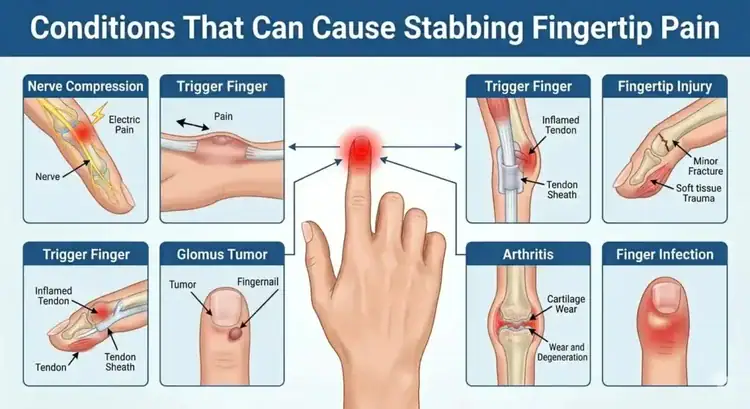
The fingertips contain tiny sensory nerves that allow you to feel touch, temperature, and pain. When one of these nerves becomes irritated, compressed, or injured, it can cause sudden sharp, shooting, or electric shock-like pain.
This may occur after:
Common symptoms include:
Pain may worsen while typing, gripping objects, or performing repetitive hand movements.
A glomus tumor is a rare, non-cancerous growth that usually develops beneath the fingernail. Although small, it can cause severe pain because it arises from structures involved in temperature regulation.
Typical symptoms include:
Many patients experience symptoms for months or even years before the condition is correctly diagnosed.
Trigger finger occurs when the tendon responsible for bending the finger becomes inflamed and cannot glide smoothly through its protective sheath.
This condition may cause:
Trigger finger is commonly seen in people who frequently perform repetitive gripping activities, use hand tools, or have diabetes.
Even a small injury can cause significant fingertip pain because the fingertips contain thousands of sensory nerve endings.
Common injuries include:
Pain may continue even after the skin appears to have healed, especially if deeper tissues were affected.
Arthritis affecting the small joints of the fingers may lead to pain that extends toward the fingertip.
Symptoms may include:
The discomfort usually develops gradually and may worsen over time if left untreated.
Infections involving the skin, nail fold, or deeper tissues can produce severe throbbing or stabbing pain.
Warning signs include:
Prompt treatment is important to prevent the infection from spreading.
Paronychia is an infection of the skin surrounding the fingernail, often caused by bacteria entering through small cuts or damaged skin.
Symptoms include:
Early treatment usually prevents the infection from becoming more serious.
A felon is a bacterial infection involving the soft pad at the tip of the finger.
Common symptoms include:
Because pressure builds inside the fingertip, a felon requires prompt medical attention to prevent damage to surrounding tissues.
A subungual hematoma occurs when blood collects beneath the fingernail, usually after a crush injury.
Symptoms include:
Small hematomas may heal naturally, while larger ones sometimes require drainage to relieve pressure.
Tiny objects such as glass fragments, wooden splinters, or thorns can become embedded beneath the skin and continue causing sharp pain.
You may notice:
If the object remains trapped, medical removal may be necessary.
While some cases of fingertip pain improve with rest and simple home care, persistent or worsening symptoms should not be ignored.
Consult a Hand & Wrist Specialist if you experience:
Early diagnosis often leads to more effective treatment and faster recovery.
Seek immediate medical attention if you notice:
Prompt treatment can help preserve finger function and prevent permanent complications.
At Krisha Hospital, Dr. Karn Maheshwari, Hand & Wrist Microsurgery Specialist, carefully evaluates fingertip pain to identify its underlying cause before recommending treatment.
Medical History
Your doctor may ask about:
Physical Examination
The affected finger is carefully examined for:
Imaging Studies
Depending on the suspected condition, diagnostic tests may include:
Specialized Clinical Tests
For selected conditions, your hand specialist may also perform:
These specialized examinations help ensure an accurate diagnosis and appropriate treatment plan.
A Real Clinical Example
One patient experienced severe fingertip pain for nearly three years. Multiple treatments provided only temporary relief because the underlying cause remained undiagnosed. After evaluation by a hand specialist, a tiny glomus tumor beneath the fingernail was identified. Following surgical removal, the patient’s pain resolved completely.
This example highlights why persistent fingertip pain should never be ignored, especially when symptoms continue despite home treatment.
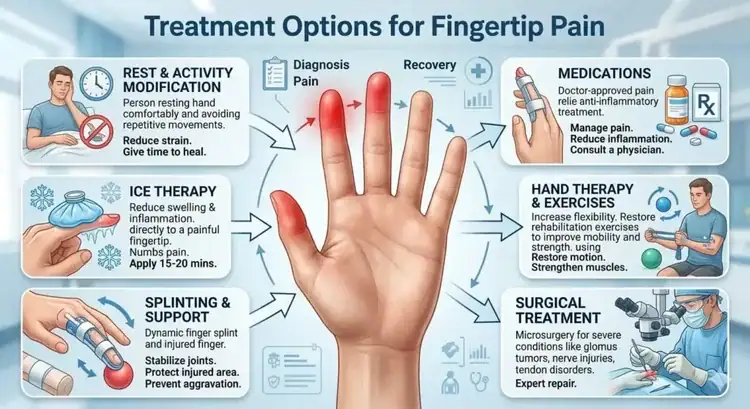
Treatment depends on the underlying cause of your fingertip pain. After identifying the exact diagnosis, your hand specialist will recommend the most appropriate treatment plan.
Reducing repetitive hand movements and avoiding activities that worsen the pain can help inflamed tissues recover, especially in cases of overuse injuries and tendon irritation.
A temporary finger splint may be recommended to support injured tendons or joints, reduce pain, and allow healing.
Anti-inflammatory medications or pain relievers may help reduce pain and swelling in selected conditions. These should always be taken under medical guidance.
Specialized hand therapy can improve:
Early rehabilitation often helps patients recover faster and regain normal hand movement.
For selected tendon-related conditions, Platelet-Rich Plasma (PRP) therapy may be considered to promote tissue healing. Your hand specialist will determine whether this treatment is suitable based on your diagnosis.
For certain inflammatory tendon conditions, ultrasound-guided injections allow medication to be delivered precisely to the affected area, improving accuracy while minimizing injury to nearby tissues.
Because glomus tumors do not resolve on their own, the definitive treatment is surgical excision.
Benefits include:
Treatment depends on symptom severity and may include:
Treatment may involve:
Early treatment helps prevent the infection from spreading to deeper tissues.
Treatment varies depending on the underlying cause and may include:
When injuries involve torn tendons, damaged nerves, or severe trauma, advanced surgical procedures may be recommended, including:
Following surgery, a structured rehabilitation program plays an important role in restoring strength and hand function.
Some mild conditions, such as minor injuries or temporary overuse, may improve with:
However, persistent, severe, or recurring fingertip pain should never be ignored, especially if it is accompanied by numbness, swelling, weakness, finger locking, or reduced movement.
Schedule an evaluation if:
A consultation with a Hand & Wrist Microsurgery Specialist can help identify problems involving the nerves, tendons, joints, or soft tissues before they become more serious.
If you’ve been experiencing sharp fingertip pain for more than a few days, or if the pain is severe, recurrent, or associated with numbness, swelling, cold sensitivity, or difficulty moving your finger, don’t wait.
Consult Dr. Karn Maheshwari, Hand & Wrist Microsurgery Specialist, for a comprehensive evaluation and personalized treatment plan. Early diagnosis and timely treatment can help relieve pain, restore hand function, and prevent long-term complications.
This article is intended for educational purposes only and should not be considered a substitute for professional medical advice, diagnosis, or treatment. If you are experiencing persistent fingertip pain, numbness, swelling, or difficulty using your hand, consult a qualified Hand & Wrist Microsurgery Specialist for a proper evaluation and personalized treatment plan.
For additional patient education, readers may refer to the following organizations:
American Society for Surgery of the Hand (ASSH)
Sharp fingertip pain may result from nerve irritation, a glomus tumor, trigger finger, infection, arthritis, a foreign body (such as a thorn or glass splinter), or an injury. A hand specialist can identify the exact cause through a clinical examination and, if needed, imaging tests.
Pain when pressing the fingertip can occur due to a bruise, infection, nerve irritation, glomus tumor, subungual hematoma (blood under the nail), or inflammation of the surrounding tissues. If the pain is severe or persistent, medical evaluation is recommended.
Yes. Although carpal tunnel syndrome mainly causes numbness and tingling in the thumb, index, middle, and part of the ring finger, some people may also experience sharp pain or burning sensations in the fingertips because of median nerve compression.
Pain caused by a nerve problem is often accompanied by symptoms such as tingling, numbness, burning sensations, electric shock-like pain, or increased sensitivity to touch. These symptoms may worsen during certain hand movements or repetitive activities.
You should consult a hand specialist if:
Early diagnosis helps identify conditions such as nerve injuries, tendon problems, glomus tumors, trigger finger, or infections before they become more difficult to treat.

Dr. Karn Maheshwari is the founder of Krisha Hand Hospital, Ahmedabad, established in 2016. He is the only FNB-qualified hand surgeon across Gujarat, Rajasthan, and Madhya Pradesh.
With MS and DNB in Orthopedics, Dr. Maheshwari specializes in treating a wide range of hand and wrist conditions, including carpal tunnel syndrome, sports hand injuries, orthopedic hand surgery, ganglion cysts, mangled hand injuries, congenital hand differences, brachial plexus palsy, cerebral palsy & spastic hand, hand tendinopathy, hand microsurgery, hand swelling, hand transplants, hand reimplantation, rheumatoid hand deformities, and peripheral nerve injuries & compressive neuropathies.
Dr. Maheshwari’s unmatched expertise and patient-centric approach ensure world-class treatment, advanced surgical solutions, and optimal recovery for patients with complex hand and wrist conditions.
WhatsApp us