- +91 75677 63301
- 24*7 Emergency Care

Why Does My Baby Have Webbed Fingers? Syndactyly Explained
- Home
- /
- Uncategorized
- /
- Why Does My Baby...

Dr. Karn Maheshwari
Medically reviewed by Dr. Karn Maheshwari, MS Ortho, DNB, FNB Hand Surgery · Krisha Hand Hospital, Ahmedabad ·

If your baby was born with two fingers that appear joined together, you may wonder whether something went wrong during development, whether it will affect hand function, and whether the fingers need to be separated.
Webbed fingers are usually caused by a congenital hand difference called syndactyly. It occurs when two or more fingers do not completely separate during development before birth. The connection may involve mainly skin and soft tissue, while some cases have deeper structural abnormalities.
The good news is that syndactyly is treatable, and many children develop good hand function after appropriate evaluation and treatment. However, the right approach depends on which fingers are involved, how extensive the connection is, and the underlying anatomy.
Table of Contents
ToggleWhat Is Syndactyly?
Syndactyly is the medical term for webbed or joined fingers or toes.
During early development in the womb, the hand initially forms as a paddle-like structure and the individual fingers gradually separate. Syndactyly occurs when two or more digits do not completely separate during this process.
It is one of the more common congenital differences affecting the hand. Syndactyly can occur by itself or, less commonly, together with other congenital or genetic conditions.
What do webbed fingers look like?
The appearance can vary significantly.
The fingers may:
- Be connected by a small amount of skin
- Remain joined for much of their length
- Appear joined up to the fingertips
- Have differences in nail development
- Have abnormal positioning or rotation
- Have underlying skeletal abnormalities in more complex cases
The middle and ring fingers are commonly affected, although other patterns can occur, including ring little finger and thumb index involvement. Multiple fingers may also be involved.
Is Webbed Fingers in a Baby the Same as Fingers Joining Together Later in Life?
No. Webbed fingers present from birth are usually a congenital condition called syndactyly. They develop before birth, when two or more fingers do not completely separate during fetal development.
This is different from a finger that becomes difficult to separate or appears joined after an injury, burn, infection, or surgery. In those situations, scarring, tissue damage, joint problems, or contracture can limit finger movement. This is an acquired problem rather than congenital syndactyly.
The key difference
Webbed fingers from birth | Finger becoming joined after injury |
Usually present at birth | Develops after an injury or other event |
Usually called syndactyly | May result from scarring, contracture, or tissue damage |
Develops before birth | Develops after birth |
May involve skin, soft tissue, or deeper structures | May involve scar tissue, tendons, joints, or damaged structures |
Evaluated as a congenital hand difference | Evaluated as an acquired hand problem |
For parents If your baby's fingers have been joined since birth, this is generally not the result of an injury or something that happened after delivery. A hand specialist can determine exactly what structures are connected and whether treatment is needed.
Why Are Some Babies Born With Webbed Fingers?
In many children, there is no single identifiable cause of syndactyly.
It develops while the baby’s hands are forming during pregnancy. In some families, syndactyly has an inherited component, while in other children it occurs without a known family history. It can also occur as part of certain genetic or congenital syndromes.
Did I Do Something During Pregnancy That Caused This?
In most cases, parents should not blame themselves.
Syndactyly develops during early hand formation before birth, and many cases occur without an identifiable cause. Having a baby with webbed fingers does not necessarily mean that something you did during pregnancy caused the condition.
A specialist may ask about family history and examine the child for other congenital hand or limb differences.
What Are the Different Types of Syndactyly?
Doctors classify syndactyly according to what structures are involved and how far the connection extends.
Type | What it means |
Simple | Mainly a connection of skin and soft tissue |
Complex | Deeper skeletal or structural abnormalities may also be present |
Complete | The connection extends to the fingertip or nail area |
Incomplete | The fingers are joined only along part of their length |
These classifications can overlap. For example, syndactyly can be simple and complete, or complex and incomplete.
Why Does the Type Matter?
Two babies may both appear to have “webbed fingers” but have very different underlying anatomy.
The type and location of syndactyly help the hand surgeon determine whether treatment is needed, which fingers should be separated, and how treatment should be planned.
Which Fingers Are Most Commonly Involved?
Syndactyly can affect different combinations of fingers.
Common patterns include:
- Middle and ring fingers
- Ring and little fingers
- Thumb and index fingers
- Multiple-digit involvement
The fingers involved can influence treatment planning. For example, involvement of a border digit such as the thumb or little finger, or fingers with significantly different lengths, may require particular attention because abnormal growth can affect hand development.
Can Webbed Fingers Be Separated?
Yes. Many cases of finger syndactyly can be surgically separated.
However, not every child needs the same type of treatment. The decision depends on:
- Which fingers are involved
- How extensive the webbing is
- Whether deeper structures are involved
- Whether the fingers have different lengths
- Whether the condition may affect growth or function
Some mild cases may be observed, while finger syndactyly that could interfere with developing hand function is often considered for surgery.
Why Might Syndactyly Surgery Be Recommended?
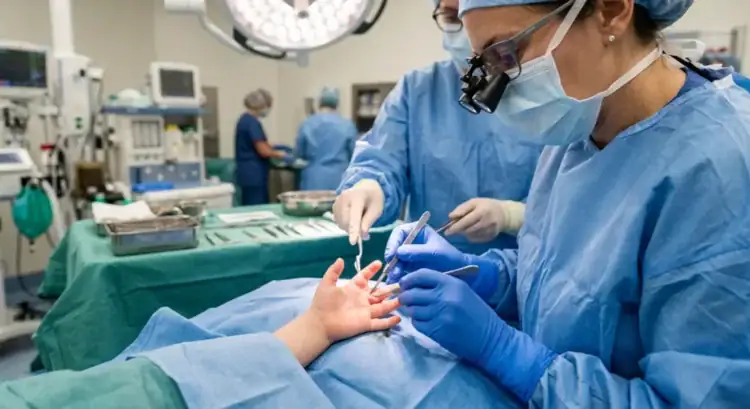
The purpose of surgery is not simply to “separate the fingers.”
Depending on the child’s anatomy, separation may be recommended to:
- Allow more independent finger movement
- Reduce interference between differently growing fingers
- Support useful hand function
- Create an appropriate web space between the digits
- Address associated structural abnormalities when present
The goal is to support appropriate finger growth, alignment, movement, and long-term hand function.
When Is Syndactyly Surgery Done?
There is no single surgery age that applies to every child with syndactyly.
The timing depends on the fingers involved and the individual anatomy. Border-digit involvement and differences in finger length may require earlier intervention, while other uncomplicated cases can often be planned later in early childhood.
Your hand surgeon will determine the appropriate timing after examining the child’s anatomy and considering how the condition may affect growth and function.
Parents should therefore avoid choosing a surgery date based only on a general age mentioned online.
How Is Syndactyly Diagnosed?
A doctor usually begins with a physical examination of the baby’s hand.
The examination helps determine:
- Which fingers are involved
- How much of the fingers are connected
- Whether movement is restricted
- Whether the nails are affected
- Whether there are other congenital hand differences
An X-ray may be recommended to determine whether the underlying bones are separate or whether skeletal abnormalities are present.
Additional testing may be considered in selected children if the examination suggests another congenital or genetic condition.
Can syndactyly be detected before birth?
Sometimes. Prenatal ultrasound can identify some cases of syndactyly, although many cases are first noticed after the baby is born.
What Happens During Webbed Finger Surgery?
The exact procedure depends on the child’s anatomy and the type of syndactyly.
In a typical separation procedure, the surgeon:
- Carefully separates the joined fingers
- Reconstructs the web space between the digits
- Protects important structures such as nerves, blood vessels, and tendons
- Provides appropriate tissue coverage where required
- Closes and protects the surgical area
A skin graft or other tissue-coverage technique may be required when there is not enough skin after separation.
Complex syndactyly can require more extensive reconstruction because deeper structural abnormalities may be present.
Are There Risks With Syndactyly Surgery?
As with any surgery, syndactyly separation has potential risks. Depending on the procedure and the child’s anatomy, these may include:
- Wound-healing problems
- Infection
- Scar formation
- Narrowing or recurrence of the web space
- Stiffness or movement limitations
- Differences in appearance
- Graft-related problems when a graft is required
- The need for an additional procedure in some cases
These risks vary from child to child. A hand surgeon can explain the expected benefits, limitations, and potential complications after assessing the individual anatomy.
What Is Recovery Like After Syndactyly Surgery?
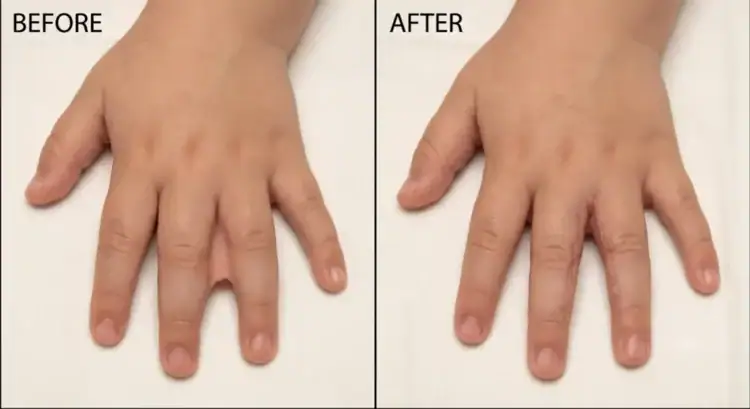
Recovery varies according to the type and complexity of the procedure.
Children may need a cast or splint after surgery to protect the reconstructed fingers while they heal. Follow-up appointments are important to monitor healing, finger growth and hand function. Some children may also benefit from occupational or hand therapy.
Parents should follow the surgeon’s instructions regarding:
- Dressing and cast care
- Protecting the surgical area protected
- Follow-up visits
- Movement or therapy
- Signs of infection or wound problems
The recovery plan should be individualized rather than based on a fixed number of days.
Will Webbed Fingers Affect My Baby's Hand Function?
It depends on the type and location of the syndactyly.
Some children with mild syndactyly have little functional limitation. In other cases, joined fingers can interfere with independent finger movement, dexterity, or normal growth of the digits.
This can be particularly important when the involved fingers have significantly different lengths or when the thumb or little finger is affected.
A hand specialist can assess whether the webbing is primarily an appearance concern or whether it may interfere with function as the child grows.
What Can Parents Expect After Syndactyly Treatment?
Many children have good hand function after appropriate treatment, but outcomes vary depending on the type of syndactyly and the underlying anatomy.
The goal is not necessarily to create a completely “normal-looking” hand.
Instead, treatment aims to optimize:
- Finger growth
- Alignment
- Movement
- Hand function
- Useful hand development
Some children may require long-term follow-up to monitor growth and function.
Is Syndactyly Genetic?
Syndactyly can occur as an isolated congenital hand difference or, in some children, as part of an inherited or genetic syndrome.
Many children have no family history.
If a child has additional physical differences or there is a strong family history of congenital hand differences, the doctor may recommend further evaluation.
When Should Parents See a Hand Specialist?
If your baby is born with webbed fingers, it is reasonable to have the hand evaluated by a doctor familiar with congenital hand differences.
A specialist evaluation can determine:
- Whether the condition is simple or complex
- Whether an X-ray is needed
- Whether other congenital differences are present
- Whether surgery is recommended
- Which fingers should be separated
- The appropriate timing of treatment
- What recovery and follow-up may involve
Early assessment does not necessarily mean that surgery must happen immediately. It helps establish the safest treatment plan for the child’s individual anatomy.
When to Consult a Hand and Microsurgery Specialist
If your baby has webbed or joined fingers, an evaluation by a hand and microsurgery specialist can help determine exactly what is connected and whether treatment is necessary.
At Krisha Hand Hospital, children with congenital hand differences can be evaluated based on the individual anatomy and functional needs of the hand. The goal is not simply to separate the fingers, but to plan treatment that supports appropriate finger growth, movement and long-term hand function.
Conclusion
Webbed fingers in a baby are usually caused by syndactyly, a congenital difference that occurs when two or more fingers do not completely separate during development.
Some cases involve only skin, while others can involve deeper structures such as bones and blood vessels. Because every child’s anatomy is different, the need for surgery and the timing of treatment should be decided after a specialist evaluation.
If your baby was born with webbed fingers, early assessment can help you understand the type of syndactyly, whether it may affect hand function, and what treatment options are appropriate.
Frequently Asked Questions
Yes. Many cases of syndactyly can be treated with surgery that separates the joined fingers. The need for surgery and the surgical approach depend on the type and severity of the condition.
Syndactyly is one of the more common congenital limb differences. Reported frequency is approximately 1 in 2,000–3,000 births, although estimates vary between populations and definitions.
Not every child has the same treatment needs. Mild cases may sometimes be observed, while finger syndactyly that could interfere with growth or function is often considered for surgery.
There is no universal age. Timing depends on the fingers involved, their relative lengths, the type of syndactyly, and the child’s individual anatomy. Border-digit involvement may require earlier treatment.
Some cases can be detected during a prenatal ultrasound, but many are first noticed after birth.
It can. Syndactyly may occur in families or as part of certain genetic conditions, but many children have no known family history.
Many children have good function and development after appropriate treatment, but outcomes depend on the type of syndactyly and the underlying anatomy. Long-term follow-up may be recommended to monitor growth and function.
Syndactyly does not automatically mean that a child will have a disability. Its effect on hand function depends on the type of syndactyly, the digits involved, and whether deeper structures are affected.
No. Syndactyly can affect fingers or toes. In some children, it may occur along with other congenital limb differences.

Dr. Karn Maheshwari
FNB (Hand & Microsurgery) | MS Ortho | DNB Ortho | Founder, Krisha Hand Hospital
Dr. Karn Maheshwari is the founder of Krisha Hand Hospital, Ahmedabad, established in 2016. He is the only FNB-qualified hand surgeon across Gujarat, Rajasthan, and Madhya Pradesh.
With MS and DNB in Orthopedics, Dr. Maheshwari specializes in treating a wide range of hand and wrist conditions, including carpal tunnel syndrome, sports hand injuries, orthopedic hand surgery, ganglion cysts, mangled hand injuries, congenital hand differences, brachial plexus palsy, cerebral palsy & spastic hand, hand tendinopathy, hand microsurgery, hand swelling, hand transplants, hand reimplantation, rheumatoid hand deformities, and peripheral nerve injuries & compressive neuropathies.
Dr. Maheshwari’s unmatched expertise and patient-centric approach ensure world-class treatment, advanced surgical solutions, and optimal recovery for patients with complex hand and wrist conditions.