- +91 75677 63301
- 24*7 Emergency Care

Skier’s Thumb: Symptoms, Treatment, Recovery & When Surgery Is Needed
- Home
- /
- Uncategorized
- /
- Skier’s Thumb: Symptoms, Causes...

Dr. Karn Maheshwari
Medically reviewed by Dr. Karn Maheshwari, MS Ortho, DNB, FNB Hand Surgery · Krisha Hand Hospital, Ahmedabad ·

Did you injure your thumb in a fall and now have pain, swelling, weakness or difficulty gripping or pinching?
It could be more than a simple sprain. Skier’s thumb is an injury to the ulnar collateral ligament (UCL) at the metacarpophalangeal (MCP) joint of the thumb. This ligament helps keep the thumb stable during gripping, pinching and grasping.
A UCL injury can range from a partial tear to a complete rupture or an avulsion injury. Some displaced injuries, including a Stener lesion, may require surgical treatment.
The right treatment depends on the severity, location and stability of the injury.
Table of Contents
ToggleWhat Is Skier’s Thumb?
Skier’s thumb is an acute injury to the ulnar collateral ligament (UCL) on the inner side of the thumb MCP joint.
The UCL prevents the thumb from moving too far away from the hand and provides stability during everyday movements such as:
- Pinching
- Gripping
- Holding objects
- Opening containers
- Using tools
A UCL injury can be:
- Partial tear – part of the ligament is damaged but some fibres remain intact.
- Complete tear – the ligament is fully disrupted.
- Avulsion injury – the ligament pulls away from its attachment, sometimes taking a small piece of bone with it.
- Displaced tear – the torn ligament moves away from its normal position.
Skier’s Thumb at a Glance
Feature | What it means |
Injured structure | Ulnar collateral ligament (UCL) |
Location | Inner side of the thumb MCP joint |
Common cause | Thumb forced outward during a fall or impact |
Symptoms | Pain, swelling, tenderness, weakness or instability |
Possible injuries | Partial tear, complete tear or avulsion injury |
Important complication | Stener lesion |
Treatment | Immobilization and rehabilitation or surgery, depending on the injury |
Understanding the UCL Injury
The UCL is located at the thumb MCP joint and plays an important role in keeping the joint stable.
A medical illustration can help patients understand the difference between:
Normal UCL → Partial UCL Tear → Complete UCL Tear → Avulsion Injury → Stener Lesion
This distinction is important because the treatment of a stable partial tear may be very different from that of a displaced or unstable injury.
What Causes Skier’s Thumb?
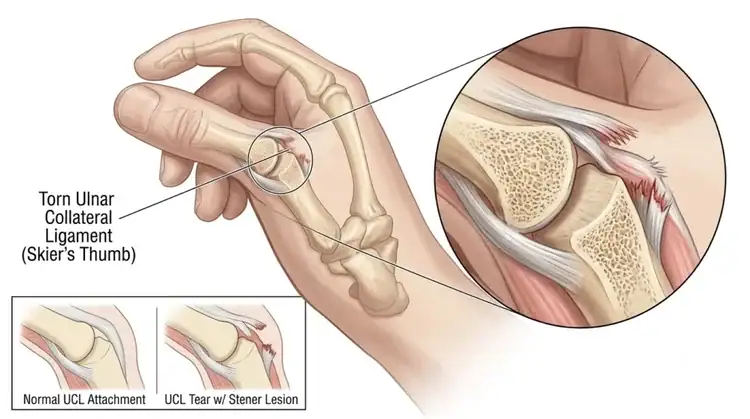
Skier’s thumb usually occurs when a sudden force pushes the thumb outward away from the hand.
The name comes from a classic skiing injury, where a person falls while holding a ski pole. However, you do not need to ski to develop a UCL injury.
It can also happen during:
- A fall onto an outstretched hand
- A sports-related impact
- A thumb being caught or forced backward or outward
- A sudden accident that places excessive stress on the thumb joint
What Are the Symptoms of Skier’s Thumb?
Common Skier’s thumb symptoms include:
- Pain around the inner side of the thumb MCP joint
- Swelling or bruising
- Tenderness around the injured ligament
- Pain while gripping or pinching
- Weak grip or pinch strength
- Difficulty using the thumb normally
- A feeling that the thumb is unstable or loose
The combination of pain and weakness during pinching or gripping can be an important clue to a UCL injury.
However, similar symptoms can occur with a thumb fracture, joint injury or other soft-tissue injury. An appropriate examination is therefore important after a significant thumb injury.
Partial vs Complete UCL Tear: What Is the Difference?

The severity and location of the ligament injury help determine treatment.
Injury | What happens | Treatment may involve |
Partial UCL tear | Part of the ligament remains intact | Immobilization followed by rehabilitation |
Complete UCL tear | The ligament is fully disrupted | Treatment depends on stability and displacement; surgery may be recommended |
Avulsion injury | Ligament pulls away with a small piece of bone | Imaging and treatment based on displacement and stability |
A complete tear does not automatically mean surgery in every case. The position of the torn ligament, joint stability and associated injuries all need to be considered.
What Is a Stener Lesion?
A Stener lesion is a displaced UCL injury that can occur after a complete tear.
In a Stener lesion, the torn UCL becomes displaced and lies superficial to the adductor pollicis aponeurosis. This abnormal position can prevent the ligament from returning to its normal attachment and healing properly.
Because of this, a Stener lesion is an important finding when determining whether Skier’s thumb surgery is required.
Stener Lesion: Normal vs Torn vs Displaced
A simple medical illustration can show:
Normal UCL → Torn UCL → Stener Lesion
The final view should clearly demonstrate the displaced UCL lying superficial to the adductor pollicis aponeurosis.
How Is Skier’s Thumb Diagnosed?
Diagnosis follows a step-by-step process:
Clinical examination → X-ray → Ultrasound/MRI when required → Assess stability and displacement → Treatment plan
- Clinical Examination
A hand and wrist specialist examines the thumb for:
- Pain and tenderness
- Swelling
- Joint stability
- Grip and pinch function
- Signs of ligament injury
Because acute injuries can be painful and swollen, the exact extent of a UCL tear may not always be clear from examination alone.
- X-ray
- An X-ray can help identify:
- A thumb fracture
- An avulsion fracture
- A small bone fragment pulled away from the UCL attachment
- Ultrasound
Ultrasound can help assess whether the UCL is:
- Intact
- Partially torn
- Completely torn
- Displaced
It may also help identify a suspected Stener lesion.
- MRI
MRI provides detailed images of the UCL and surrounding soft tissues. It may be recommended when the diagnosis or extent of the injury remains uncertain.
The findings are then considered together with thumb stability and ligament displacement to determine the appropriate treatment.
Can I Test for Skier’s Thumb at Home?
It is better not to forcefully test the stability of an injured thumb yourself.
Repeatedly pushing the thumb into an uncomfortable position can increase pain and may place additional stress on an injured ligament. It also cannot reliably tell you whether the injury is a partial tear, complete tear or displaced UCL injury.
If you have significant pain, weakness or instability after an injury, seek an appropriate medical assessment.
How Is Skier’s Thumb Treated?
Treatment depends on the severity and location of the tear, joint stability, whether the ligament is displaced, and whether an associated fracture is present.
Treatment for a Partial Tear
Many partial UCL tears can be treated without surgery using immobilization followed by rehabilitation.
A thumb splint or cast may be used to protect the ligament while it heals. BSSH states that partial tears are usually immobilized for around six weeks, followed by exercises to restore movement and strength.
When Is Surgery Needed?
Surgery may be recommended when the UCL is completely disrupted and cannot heal adequately in its normal position, particularly when there is:
- A displaced ligament
- A Stener lesion
- Significant thumb instability
- Certain displaced avulsion injuries
- Persistent instability or weakness despite appropriate non-surgical treatment
The exact treatment decision should be made after clinical assessment and, when required, imaging.
This is why simply assuming that every thumb injury needs surgery or that every thumb ligament tear will heal on its own is not appropriate.
Does Every Skier’s Thumb Need Surgery?
No.
Not every UCL injury requires surgery.
A stable partial tear may heal with immobilization and rehabilitation, while a displaced or unstable injury may require surgical repair. A Stener lesion is particularly important because the displaced ligament may not heal normally in its abnormal position.
The goal of treatment is to restore:
- Thumb stability
- Grip and pinch strength
- Movement
- Hand function
- Ability to return to normal activities
What Happens After Skier’s Thumb Treatment?
Recovery depends on the type of injury and the treatment provided. Rather than following one fixed timeline, rehabilitation generally progresses through several stages:
Protection → Immobilization → Gradual movement → Strengthening → Functional use → Return to sport/work
The exact progression varies between patients.
After non-surgical treatment, movement and strength are gradually restored following immobilization. After surgery, rehabilitation is also an important part of recovery.
Your hand surgeon or hand therapist can guide you on when to begin movement, strengthening and return to activities.
Skier’s Thumb Recovery and Rehabilitation
The aim of rehabilitation is to gradually restore:
- Thumb movement
- Grip and pinch strength
- Joint stability
- Hand function
Confidence using the thumb during daily activities
Rehabilitation exercises should be introduced at the appropriate stage of healing. The plan can differ considerably between a conservatively treated partial tear and a surgically repaired complete tear.
Skier’s Thumb vs Gamekeeper’s Thumb
Both terms relate to injuries of the thumb UCL.
Skier’s thumb generally refers to an acute traumatic UCL injury, while Gamekeeper’s thumb has traditionally been associated with chronic or repetitive stretching of the same ligament.
The terms can overlap in clinical use. The more important question is the actual condition of the UCL — including whether it is torn, displaced or associated with instability.
Skier’s Thumb vs a Thumb Fracture
Pain after a thumb injury does not necessarily mean that only the ligament is injured.
A UCL injury can occur together with an avulsion fracture, where the ligament pulls away a small piece of bone from its attachment.
An X-ray can help identify this type of injury.
Persistent pain, swelling, weakness or instability after a thumb injury should therefore not automatically be assumed to be a simple sprain.
Red Flags: When Should You Seek Medical Assessment?
Seek medical assessment after a thumb injury if:
- Your thumb feels unstable
- You cannot pinch properly
- Your grip suddenly becomes weak
- Significant swelling or bruising develops
- Pain persists after the injury
- You suspect a fracture
- Thumb movement or function is significantly affected
Early assessment can help distinguish a simple sprain from a significant UCL injury that may need specific treatment.
What Should You Do Immediately After a Thumb Injury?
Until the injury can be assessed:
- Rest the injured hand
- Avoid activities that increase pain
- Protect the thumb from further stress
- Apply ice wrapped in a cloth for short periods
- Keep the hand elevated if swelling is significant
- Seek medical assessment if symptoms are significant or persistent
Avoid repeatedly bending or forcefully testing the injured thumb.
What Happens If a UCL Injury Is Ignored?
A significant UCL injury that does not heal properly can cause persistent thumb weakness or instability, making gripping and pinching difficult.
Some chronic injuries may eventually require reconstructive treatment or other intervention.
This does not mean every thumb injury becomes serious. It means that a significant injury should be correctly diagnosed rather than assumed to be a simple sprain.
Key point If you have recently injured your thumb and are having difficulty gripping, pinching or using the thumb normally, seek an appropriate medical evaluation rather than repeatedly testing the injured joint yourself.
Get the Right Assessment for a Thumb Ligament Injury
A thumb injury may look minor from the outside while involving a significant ligament tear underneath.
If you have persistent thumb pain, swelling, weakness or instability after an injury, Dr. Karn Maheshwari, a hand and wrist microsurgery specialist at Krisha Hospital, Ahmedabad, can assess the injury and determine whether you need immobilization, rehabilitation or surgical treatment.
At Krisha Hospital, patients with hand and wrist injuries can be evaluated for conditions involving ligaments, tendons, nerves, fractures and other complex hand problems. Treatment is planned according to the individual injury rather than using the same approach for every patient.
Frequently Asked Questions
Pain, swelling and tenderness around the thumb MCP joint after an injury, particularly with weakness during gripping or pinching, can suggest a UCL injury. Diagnosis requires appropriate clinical assessment and sometimes imaging.
Some partial and appropriately selected UCL injuries can heal with immobilization and rehabilitation. Displaced injuries, including Stener lesions, may require surgery.
It is a displaced UCL tear in which the torn ligament lies superficial to the adductor pollicis aponeurosis, preventing normal healing.
The duration depends on the type and severity of the injury. BSSH notes that partial tears are usually immobilized for around six weeks before exercises are introduced.
Rehabilitation exercises are usually introduced according to the stage of healing and the treatment received. Do not start strengthening exercises without appropriate medical guidance after an acute ligament injury.
Many patients can return to normal activities after appropriate treatment and rehabilitation, but the timing depends on healing, stability, strength and the sport involved. Your treating surgeon or therapist should guide your return to activity.

Dr. Karn Maheshwari
FNB (Hand & Microsurgery) | MS Ortho | DNB Ortho | Founder, Krisha Hand Hospital
Dr. Karn Maheshwari is the founder of Krisha Hand Hospital, Ahmedabad, established in 2016. He is the only FNB-qualified hand surgeon across Gujarat, Rajasthan, and Madhya Pradesh.
With MS and DNB in Orthopedics, Dr. Maheshwari specializes in treating a wide range of hand and wrist conditions, including carpal tunnel syndrome, sports hand injuries, orthopedic hand surgery, ganglion cysts, mangled hand injuries, congenital hand differences, brachial plexus palsy, cerebral palsy & spastic hand, hand tendinopathy, hand microsurgery, hand swelling, hand transplants, hand reimplantation, rheumatoid hand deformities, and peripheral nerve injuries & compressive neuropathies.
Dr. Maheshwari’s unmatched expertise and patient-centric approach ensure world-class treatment, advanced surgical solutions, and optimal recovery for patients with complex hand and wrist conditions.