- +91 75677 63301
- 24*7 Emergency Care
All Cashless / Insurance Facilities Available •
All Cashless / Insurance Facilities Available •
All Cashless / Insurance Facilities Available


Medically reviewed by Dr. Karn Maheshwari, MS Ortho, DNB, FNB Hand Surgery · Krisha Hand Hospital, Ahmedabad ·
Has your doctor advised carpal tunnel surgery? Are you now wondering whether to choose open surgery or the keyhole (endoscopic) method, how soon you can go back to work, and whether the problem can come back?
Both operations do the same job. They release the ligament that presses on the median nerve at the wrist. The difference is how the surgeon reaches that ligament, and this changes the size of the cut, the first few weeks of recovery and who suits each method.
This guide compares the two methods, explains what research shows, and helps you prepare for your discussion with a hand surgeon. If you are not sure you have carpal tunnel syndrome yet, start with the warning signs of carpal tunnel syndrome.
The carpal tunnel is a narrow passage at the front of the wrist. When the median nerve is squeezed inside it, you get numbness, tingling and night pain in the thumb, index, middle and part of the ring finger. Read more on what causes carpal tunnel syndrome.
Carpal tunnel release is a short operation that cuts the ligament forming the roof of this tunnel (the transverse carpal ligament). The ligament heals with more room underneath, so the pressure on the nerve stays off. Night-time tingling and pain often ease within days.
Table of Contents
ToggleFeature | Open release | Endoscopic (keyhole) release |
Cut | One cut of about 2 to 3 cm in the palm, near the wrist | One or two small cuts, under 1 cm, near the wrist crease |
How the ligament is cut | Under direct view | Using a thin camera (endoscope) and a screen |
Anaesthesia | Usually local; the hand is numbed | Usually local; the hand is numbed |
Hospital stay | Day surgery, same-day discharge | Day surgery, same-day discharge |
Return to work | Usual timeline | About a week sooner on average in studies |
Long-term symptom relief | Good | Similar to open release |
Often chosen for | Most patients, repeat surgery, or when a direct view is needed | Selected patients who want a quicker early recovery |
The hand and wrist are numbed with a local anaesthetic. The surgeon makes a cut of about 2 to 3 cm in the palm near the wrist, sees the ligament and the nerve directly, and divides the ligament. The skin is closed with stitches and a padded dressing is applied. The operation usually takes about 20 minutes, and you go home the same day.
Open release is the standard operation and has been used for decades. Its main advantage is the direct view. The surgeon can see the nerve clearly and deal with any other problem inside the tunnel at the same time.
In endoscopic (keyhole) release, the surgeon makes one or two small cuts, each under 1 cm, near the wrist crease. A thin camera called an endoscope is passed under the ligament. Watching on a screen, the surgeon divides the ligament from underneath, without opening the skin and tissue of the palm.
Because the palm is not opened, many patients have less tenderness in the palm in the first few weeks and return to daily tasks a little sooner. Endoscopic carpal tunnel release is one of the procedures Dr. Karn Maheshwari performs at Krisha Hospital, Ahmedabad.
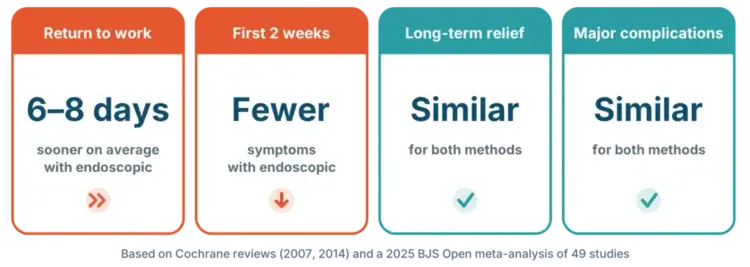
Two Cochrane reviews, which pool the results of many clinical trials, and a 2025 analysis of 49 studies with more than 4,500 patients have compared the two methods. This is what they found:
Outcome | What studies found |
Return to work | Endoscopic release allowed people to return to work or daily activities about 6 to 8 days sooner on average |
First 2 weeks | Endoscopic release may cause fewer symptoms in the first two weeks |
Grip strength | Slightly better in the first three months after endoscopic release |
Scar tenderness | Less common after endoscopic release in the studies that measured it |
Long-term symptom relief | No clear difference between the two methods |
Major complications | Similar for both methods |
Recurrence and repeat surgery | No clear difference |
In short, both operations relieve symptoms equally well in the long run. Endoscopic (keyhole) release mainly offers a quicker and more comfortable first few weeks. The evidence for some of these outcomes is of low quality, so the reviews suggest the choice should be guided by the surgeon’s assessment and the patient’s preference.
Will I need hand therapy after surgery?
Not sure which option suits you? Dr. Karn Maheshwari can examine your hand, review your nerve test and explain both options.
Mild carpal tunnel syndrome often improves without an operation. In an NHS decision guide, out of every 100 people:
Hand exercises can also help in mild cases. See our therapeutic exercise programme for carpal tunnel syndrome and does carpal tunnel syndrome resolve on its own?
Surgery is usually advised when symptoms have not improved after 6 to 12 weeks of these treatments, when symptoms are severe or long-standing, or when tests show nerve damage or muscle wasting.

For more detail, read our complete guide to carpal tunnel surgery.
Time after surgery | What to expect |
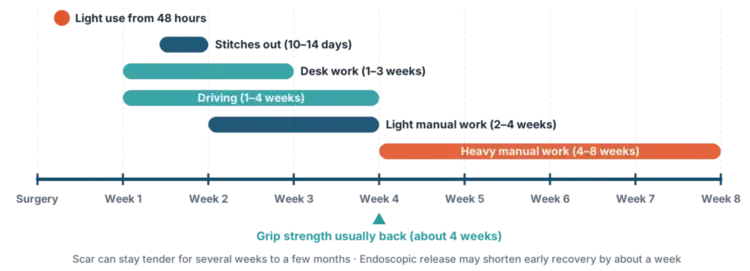
First 2 days | Keep the hand raised at heart level or higher. Light use, such as eating with a spoon, can usually start after 48 hours. |
10 to 14 days | Stitches removed |
1 to 3 weeks | Desk or office work |
1 to 4 weeks | Driving, once you can grip the wheel firmly and react safely |
2 to 4 weeks | Light manual work |
About 4 weeks | Grip strength usually returns |
4 to 8 weeks | Heavy manual work |
Night-time numbness and pain often ease quickly. Daytime numbness can take longer, especially if the nerve was badly compressed before surgery, and symptoms can keep improving for up to two years. The scar may stay tender for several weeks to a few months. Keyhole release may shorten the early part of this recovery by about a week on average. Hand therapy is not needed by everyone, but it helps if stiffness or weakness persists.
Your surgeon will guide you on the exact timeline for your work and daily routine.
It is uncommon. In an NHS decision guide, about 30 in every 1,000 people needed a second operation. Studies have not found a clear difference in recurrence or repeat surgery between endoscopic and open release. Tell your surgeon about conditions such as diabetes or thyroid problems, as they are linked with carpal tunnel syndrome and can affect recovery.
Carpal tunnel release is one of the most common hand operations, and serious problems are rare. In an NHS decision guide, out of every 1,000 people:
Other possible problems include a tender scar, temporary weakness or stiffness, and symptoms that do not go away fully when the nerve was already badly damaged before surgery.
If you notice any of these, call Krisha Hospital on +91 75677 63301.
Long-standing, severe pressure can cause permanent damage to the median nerve. If you wait until there is constant numbness, severe nerve damage or wasting of the thumb muscles, surgery may not fully relieve your symptoms. This does not mean every case needs urgent surgery, but symptoms that keep getting worse should be checked early.
Dr. Karn Maheshwari, hand and wrist surgeon at Krisha Hospital, Ahmedabad, performs both open and endoscopic carpal tunnel release. He can examine your hand, review your nerve test and explain which option suits you. Patients from outside Ahmedabad or abroad can start with an online consultation. Learn more about carpal tunnel syndrome treatment at Krisha Hospital.
Both give similar long-term relief. Endoscopic release may allow a faster early recovery, about a week sooner back to work on average. Your surgeon will suggest the method that suits your hand.
The hand is numbed with a local anaesthetic, so you should not feel pain during the operation. Afterwards there is some soreness for a few days, and the scar can stay tender for several weeks.
Usually yes. At Krisha Hospital, carpal tunnel release is commonly done wide-awake under local anaesthesia, so general anaesthesia is not needed.
Desk work is often possible in 1 to 3 weeks, light manual work in 2 to 4 weeks and heavy manual work in 4 to 8 weeks. Keyhole release may shorten this by about a week.
Usually after 1 to 4 weeks, once you can grip the steering wheel firmly and react safely.
Keep the dressing clean and dry until your surgeon advises otherwise, usually until the stitches are removed.
It is uncommon. About 30 in 1,000 people need a second operation, with no clear difference between the two methods.
No. The decision is based on your symptoms, examination and nerve test together. Some people with mild findings do well with a splint, an injection or exercises.

Dr. Karn Maheshwari is the founder of Krisha Hand Hospital, Ahmedabad, established in 2016. He is the only FNB-qualified hand surgeon across Gujarat, Rajasthan, and Madhya Pradesh.
With MS and DNB in Orthopedics, Dr. Maheshwari specializes in treating a wide range of hand and wrist conditions, including carpal tunnel syndrome, sports hand injuries, orthopedic hand surgery, ganglion cysts, mangled hand injuries, congenital hand differences, brachial plexus palsy, cerebral palsy & spastic hand, hand tendinopathy, hand microsurgery, hand swelling, hand transplants, hand reimplantation, rheumatoid hand deformities, and peripheral nerve injuries & compressive neuropathies.
Dr. Maheshwari’s unmatched expertise and patient-centric approach ensure world-class treatment, advanced surgical solutions, and optimal recovery for patients with complex hand and wrist conditions.
WhatsApp us