- +91 75677 63301
- 24*7 Emergency Care
All Cashless / Insurance Facilities Available •
All Cashless / Insurance Facilities Available •
All Cashless / Insurance Facilities Available


Medically reviewed by Dr. Karn Maheshwari, MS Ortho, DNB, FNB Hand Surgery · Krisha Hand Hospital, Ahmedabad ·

Finger pain when bending can make simple daily activities such as writing, typing, gripping objects, or opening a bottle uncomfortable. While occasional discomfort may occur after overuse, persistent finger pain may indicate an underlying condition affecting the tendons, joints, ligaments, nerves, or bones of the finger.
At Krisha Hospital, Dr. Karn Maheshwari, a Fellowship trained Hand & Wrist Microsurgery Specialist, frequently treats patients with conditions ranging from trigger finger and sports hand injuries to complex tendon injuries, nerve compression disorders, finger fractures, and replantation hand surgery. Identifying the exact cause early can help prevent long-term stiffness, loss of movement, and permanent hand dysfunction
Table of Contents
ToggleFinger pain is a common musculoskeletal complaint that affects people of all ages. One of its leading causes, trigger finger, affects approximately 2–3% of adults, while people with diabetes have a significantly higher risk, with studies reporting prevalence rates of up to 10%.
The condition is also more common in individuals who perform repetitive gripping activities, including office workers, athletes, factory workers, musicians, and healthcare professionals.
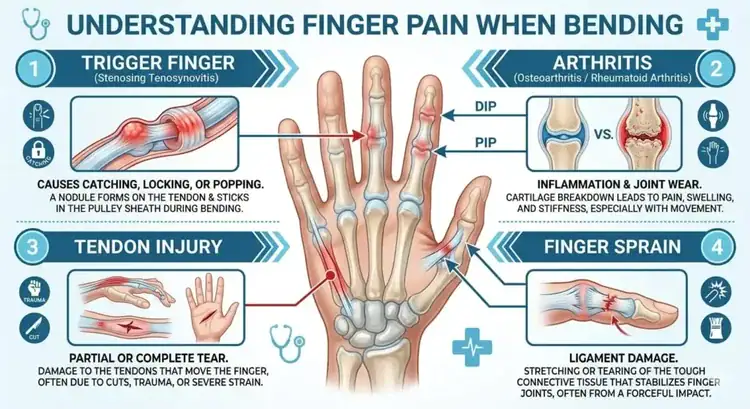
Finger pain while bending may occur due to a variety of conditions, ranging from minor overuse injuries to chronic joint disorders. Understanding the underlying cause helps determine the most effective treatment.
Trigger finger is one of the most common reasons people experience pain while bending a finger. It develops when the tendon responsible for finger movement becomes inflamed or thickened, making it difficult to glide smoothly through its protective sheath.
As the condition progresses, the finger may click, catch, or even lock in a bent position.
Common symptoms include:
Arthritis is another common cause of finger pain and stiffness, particularly in middle-aged and older adults.
Osteoarthritis
Osteoarthritis occurs when the protective cartilage inside the finger joints gradually wears away, causing pain, stiffness, and reduced flexibility.
Rheumatoid Arthritis
Rheumatoid arthritis is an autoimmune disease that causes chronic inflammation of the joint lining. It often affects multiple finger joints simultaneously and may gradually lead to joint deformity if left untreated.
Common symptoms include:
Tendons connect the muscles of your forearm to the bones of your fingers, allowing smooth bending and straightening movements. Repetitive hand use, sports injuries, heavy lifting, or sudden trauma can irritate or damage these tendons, leading to pain during movement.
Common symptoms include:
In more severe cases, tendon injuries may require specialized treatment such as hand therapy, tendon repair surgery, or microsurgical reconstruction to restore normal finger function.
A finger sprain occurs when the ligaments supporting the finger joint are stretched or torn. These injuries commonly occur during sports, falls, workplace accidents, or sudden twisting of the finger.
Symptoms often include:
Most mild sprains improve with appropriate rest and rehabilitation, while severe ligament injuries may require surgical repair.
Even a small fracture can cause significant pain when bending the finger. Finger fractures commonly result from falls, crush injuries, sports accidents, or direct impact.
Warning signs include:
Early diagnosis and appropriate treatment help ensure proper bone healing while reducing the risk of permanent stiffness, deformity, or loss of hand function.
Since several conditions can cause finger pain while bending, an accurate diagnosis is essential before starting treatment.
At Krisha Hospital, evaluation typically begins with a detailed clinical examination, followed by imaging tests when required.
Depending on your symptoms, our hand specialist may recommend:
Clinical Examination
Our doctor will assess:
X-ray
An X-ray is usually recommended if a fracture, dislocation, or arthritis is suspected.
Ultrasound
Ultrasound helps evaluate inflamed tendons, trigger finger, and certain soft tissue injuries in real time.
MRI (Selected Cases)
MRI may be advised for complex tendon injuries, ligament tears, nerve involvement, or when symptoms persist despite initial treatment.
Accurate diagnosis allows the underlying problem to be treated effectively rather than simply relieving the pain.
Depending on the underlying condition, finger pain may also be accompanied by:
While mild finger pain may improve with rest, persistent or worsening symptoms should not be ignored. Early diagnosis can help prevent permanent stiffness, reduced hand function, and long-term complications.
You should consult a hand specialist if you experience:
Early evaluation often leads to more effective treatment and faster recovery.
Treatment depends on the underlying cause, severity of symptoms, and how long the condition has been present. After identifying the exact cause, your hand specialist will recommend a personalized treatment plan.
Rest and Activity Modification
Reducing repetitive gripping, lifting, or activities that aggravate the finger allows inflamed tissues to recover while preventing further damage.
Ice Therapy
Applying an ice pack for 15–20 minutes, several times a day during the first 48 hours, may help reduce pain and swelling.
Splinting
A finger splint helps protect the injured finger, reduce movement, and support proper healing in selected tendon, ligament, and joint conditions.
Medications
Anti-inflammatory medications may be recommended to reduce pain and swelling, depending on the underlying diagnosis and your medical history.
Hand Therapy and Rehabilitation
A structured hand therapy program can improve flexibility, restore strength, reduce stiffness, and help patients safely return to daily activities. Early rehabilitation is particularly important after tendon injuries, fractures, and surgery.
Corticosteroid Injections
For conditions such as trigger finger, corticosteroid injections may reduce inflammation around the tendon sheath and improve finger movement, especially when conservative treatment has not been effective.
PRP (Platelet-Rich Plasma) Therapy
In selected patients, PRP therapy may be considered to support the healing of certain tendon and soft tissue injuries. Your hand specialist will determine whether this treatment is appropriate based on your condition.
Ultrasound-Guided Injections
For specific tendon and joint conditions, ultrasound-guided injections allow medication to be delivered more accurately to the affected area, improving treatment precision while minimizing discomfort.
Tendon Repair and Microsurgical Reconstruction
Severe tendon injuries, complex hand trauma, or nerve-related conditions may require tendon repair surgery or microsurgical reconstruction. These advanced procedures aim to restore finger movement, strength, sensation, and overall hand function.
If your finger pain is accompanied by locking, clicking, or difficulty straightening the finger, it may indicate trigger finger, a condition that responds well to early evaluation and specialized treatment before symptoms become severe.
Early diagnosis and treatment can often relieve symptoms before the condition progresses, reducing the likelihood of surgery.
Persistent finger pain should never be considered a normal part of aging or daily activities. Whether the cause is trigger finger, arthritis, a tendon injury, a ligament sprain, or a finger fracture, early diagnosis can help prevent long-term stiffness, permanent joint damage, and loss of hand function.
At Krisha Hospital, Dr. Karn Maheshwari, a Fellowship-trained Hand & Wrist Microsurgery Specialist, provides comprehensive evaluation and advanced treatment for a wide range of hand conditions, including sports hand injuries, tendon injuries, nerve compression disorders, finger fractures, and complex microsurgical reconstruction.
Most finger conditions respond well to timely treatment, making early consultation the best way to restore comfort, movement, and hand function.
If you’re experiencing finger pain while bending, finger locking, stiffness, swelling, or difficulty gripping objects, don’t wait for the symptoms to worsen.
Schedule a consultation with Dr. Karn Maheshwari, Hand & Wrist Microsurgery Specialist, for a comprehensive evaluation and a personalized treatment plan designed to help you regain pain-free hand function.
This article is intended for educational purposes only and should not be considered a substitute for professional medical advice, diagnosis, or treatment. If you have persistent finger pain, swelling, deformity, or difficulty moving your finger, consult a qualified hand specialist for an accurate diagnosis and appropriate treatment.
The following organizations provide reliable educational information on hand conditions, tendon disorders, arthritis, and finger injuries:
American Society for Surgery of the Hand (ASSH)
Finger pain while bending is commonly caused by trigger finger, arthritis, tendon injuries, ligament sprains, or finger fractures. The exact cause depends on your symptoms, medical history, and physical examination. If the pain persists for more than a few days or affects your daily activities, consult a hand specialist for an accurate diagnosis.
Yes. Trigger finger is one of the most common causes of pain while bending a finger. It occurs when an inflamed tendon cannot glide smoothly through its sheath, leading to pain, stiffness, clicking, or even locking of the affected finger.
No. While arthritis is a common cause, finger pain may also result from tendon injuries, trigger finger, ligament sprains, sports injuries, nerve compression, or fractures. A proper medical evaluation helps determine the underlying cause and the most appropriate treatment.
Clicking or locking during finger movement is most commonly associated with trigger finger, where the tendon catches as it moves through its sheath. Persistent locking or difficulty straightening the finger should be evaluated early, as treatment is often more effective before symptoms become severe.
The best treatment depends on the underlying cause. Mild conditions may improve with rest, splinting, medications, and hand therapy, while more complex problems such as trigger finger, tendon injuries, or fractures may require injections or surgery. A hand specialist can recommend the most appropriate treatment after a proper evaluation.
Some minor finger injuries improve with rest and activity modification. However, pain that persists, repeatedly returns, or is accompanied by swelling, locking, or reduced movement should not be ignored, as it may indicate a condition requiring medical treatment.
Diagnosis usually begins with a detailed clinical examination. Depending on your symptoms, your doctor may recommend an X-ray to detect fractures, ultrasound to evaluate tendons and soft tissues, or an MRI for complex tendon, ligament, or nerve injuries.

Dr. Karn Maheshwari is the founder of Krisha Hand Hospital, Ahmedabad, established in 2016. He is the only FNB-qualified hand surgeon across Gujarat, Rajasthan, and Madhya Pradesh.
With MS and DNB in Orthopedics, Dr. Maheshwari specializes in treating a wide range of hand and wrist conditions, including carpal tunnel syndrome, sports hand injuries, orthopedic hand surgery, ganglion cysts, mangled hand injuries, congenital hand differences, brachial plexus palsy, cerebral palsy & spastic hand, hand tendinopathy, hand microsurgery, hand swelling, hand transplants, hand reimplantation, rheumatoid hand deformities, and peripheral nerve injuries & compressive neuropathies.
Dr. Maheshwari’s unmatched expertise and patient-centric approach ensure world-class treatment, advanced surgical solutions, and optimal recovery for patients with complex hand and wrist conditions.
WhatsApp us