- +91 75677 63301
- 24*7 Emergency Care
All Cashless / Insurance Facilities Available •
All Cashless / Insurance Facilities Available •
All Cashless / Insurance Facilities Available


Medically reviewed by Dr. Karn Maheshwari, MS Ortho, DNB, FNB Hand Surgery · Krisha Hand Hospital, Ahmedabad ·
You first noticed a small, firm lump in your palm — maybe under the ring finger or little finger. You thought nothing of it. Months or years later, that finger has started to bend slowly toward the palm, and now you cannot straighten it fully no matter how hard you try.
This is Dupuytren’s contracture — a condition that progressively tightens the connective tissue (fascia) in the palm, causing one or more fingers to curl permanently inward. It is not painful in most cases, but it becomes significantly disabling as it progresses. (Not to be confused with trigger finger, which causes a different kind of finger locking.)
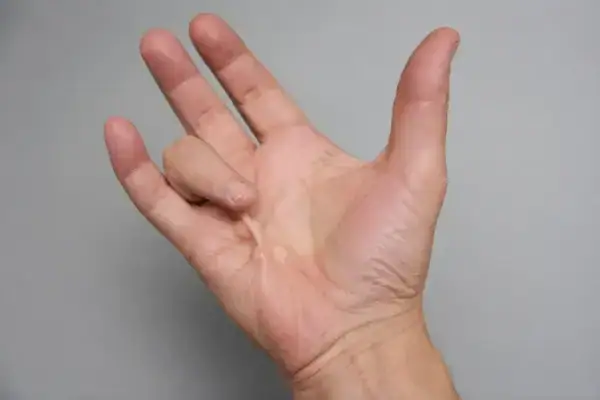
Table of Contents
ToggleSeveral risk factors increase the likelihood of developing this condition:
Dupuytren’s progresses through three recognisable stages:
| Stage | What You Notice | Finger Bending? |
|---|---|---|
| Stage 1 — Nodule | Firm, painless lump (nodule) in the palm. Skin may dimple. | No contracture yet |
| Stage 2 — Cord | A thick cord develops under the skin, extending toward the finger. | Mild bend begins (10–30°) |
| Stage 3 — Contracture | Finger is bent significantly into the palm. Can’t lay hand flat. | 30° or more — often 60–90° |
The ring finger is most commonly affected, followed by the little finger. Both fingers can be affected simultaneously. The thumb and index finger are rarely affected. In advanced cases, the finger bends so severely that it digs into the palm, causing skin hygiene problems.
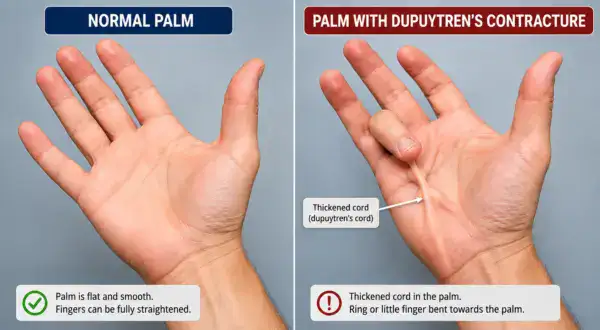
Place your hand flat on a table, palm down. If you cannot lay your hand completely flat with all fingers touching the surface, this is a positive “table-top test” — an indicator that Dupuytren’s contracture has progressed to the point where intervention should be considered.
There is no medication or injection that reverses Dupuytren’s contracture completely. Treatment options aim to straighten the finger and slow recurrence:
A needle is used to break the cord through small punctures in the skin — no incision needed. It is performed under local anaesthesia in the clinic. Recovery is fast (days), but recurrence rates are higher compared to surgery. Best suited for mild to moderate contractures in older or medically unfit patients.
An enzyme injection (clostridial collagenase) is injected into the cord to dissolve it. The finger is then straightened 1–2 days later. Effective for single-cord contractures. Currently limited availability in India but available at specialist centres.
The standard and most durable surgical option. Under regional block or general anaesthesia, an incision is made in the palm and the diseased fascia (the cord) is carefully removed. The finger is then straightened.
| Timeline | What Happens |
|---|---|
| Day 1–5 | Bulky hand bandage. Fingers elevated. No driving. |
| Week 1–2 | Wound check, sutures remain. Gentle finger bending begins. |
| Week 2–6 | Hand therapy critical — splinting to maintain extension, scar massage. |
| Week 6–12 | Gradual return to work and activities. Night splint continues. |
| 6–12 months | Full scar maturation. Most patients maintain good extension long-term. |
 After Surgery — Keys to a Good Recovery
Dupuytren’s contracture is a progressive hand condition that can slowly make it difficult to fully straighten your fingers, affecting daily activities like shaking hands, gripping objects, typing or putting your hand in a pocket. While it may begin as a small lump or thickened cord in the palm, the condition can gradually worsen over time if left untreated.
The good news is that early diagnosis and proper treatment can help improve hand function and prevent severe finger deformity. Depending on the stage of the condition, treatment may include observation, injections, minimally invasive procedures or surgery. If you notice your fingers starting to bend permanently or feel tight cords in your palm, consulting a hand specialist at the right time can make a significant difference in recovery and long-term hand movement.
Earlier treatment gives better, longer-lasting results. Dr. Karn Maheshwari at Krisha Hand Hospital, Ahmedabad will assess your Dupuytren’s and recommend the most appropriate treatment for your stage.

Dr. Karn Maheshwari is the founder of Krisha Hand Hospital, Ahmedabad, established in 2016. He is the only FNB-qualified hand surgeon across Gujarat, Rajasthan, and Madhya Pradesh.
With MS and DNB in Orthopedics, Dr. Maheshwari specializes in treating a wide range of hand and wrist conditions, including carpal tunnel syndrome, sports hand injuries, orthopedic hand surgery, ganglion cysts, mangled hand injuries, congenital hand differences, brachial plexus palsy, cerebral palsy & spastic hand, hand tendinopathy, hand microsurgery, hand swelling, hand transplants, hand reimplantation, rheumatoid hand deformities, and peripheral nerve injuries & compressive neuropathies.
Dr. Maheshwari’s unmatched expertise and patient-centric approach ensure world-class treatment, advanced surgical solutions, and optimal recovery for patients with complex hand and wrist conditions.
WhatsApp us